


WOER EV DC Charging Connectors
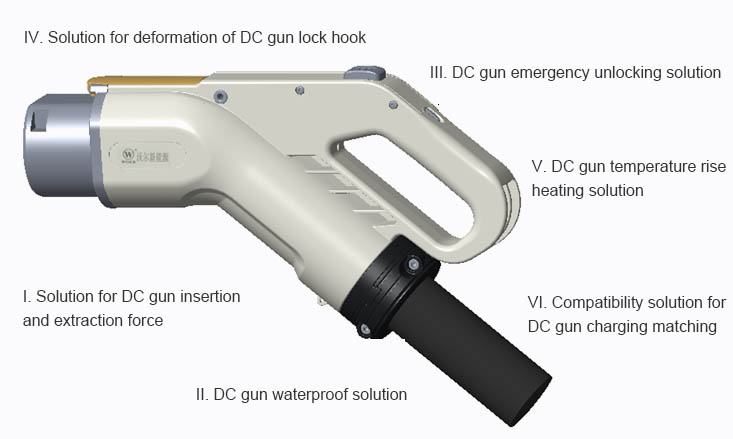
Ⅰ. Optimizing Insertion and Extraction Force
According to GB/T 20234.1 requirements, the insertion and extraction force of DC charging connectors must be ≤ 140 N. However, in real-world charging scenarios (especially at poorly positioned stations), users often find high insertion forces physically demanding.
To ensure an effortless, user-friendly charging experience for everyone, Woer has optimized the internal structure of our 3rd-Generation DC Connector. This structural refinement guarantees a significantly smoother plugging process, reducing the force to less than 120 N.
|
Charging connector Brands |
Rechargeable Holder Brands |
Insertion force/withdrawal force test (N) |
||||
|
1 |
2 |
3 |
4 |
5 |
||
|
WOER's third DC charging connector |
Brand A DC Block |
118/112 |
117/98 |
103/91 |
109/99 |
113/105 |
|
Brand B DC Block |
98/78 |
101/85 |
93/76 |
100/91 |
95/74 |
|
|
Woer DC Block |
110/106 |
103/95 |
105/87 |
112/101 |
95/85 |
|
Ⅱ. Premium IP67 Waterproofing Solution
While the standard regulatory requirement (GB/T 20234.1) dictates an IP54 protection level, long-term outdoor exposure exposes connectors to extreme risks, such as severe rainstorms or accidental drops into puddles, leading to water ingress.
To eliminate these safety hazards, Woer developed an advanced individual sealing and waterproofing structure for our 3rd-Gen DC Connector. It achieves an outstanding IP67 protection rating, far exceeding national and international standards to ensure absolute safety in harsh environments.
Ⅲ. Innovative Emergency Mechanical Unlocking
Traditional key-based emergency unlocking systems on the market frequently trigger customer complaints due to three core vulnerabilities:
- Aesthetic & Loss Risks: The unlocking key hangs externally on the connector, which affects the sleek product aesthetics and is easily lost;
- Clogging Issues: Unlocking holes are highly prone to blockage from mud, dust, and environmental debris;
- Component Damage: Unfamiliar operators often misalign the key, risking damage to internal electronic components.
Alternative tether-based (pull rope) systems also pose a risk of snapping over extended use, rendering the backup unlock useless.
The Woer Solution: Our 3rd-Gen DC Connector introduces a highly reliable Spring-Button Unlocking Method. It eliminates the need for external keys or vulnerable pull ropes, offering a robust, intuitive, and error-free backup release mechanism.
Ⅳ. Anti-Deformation Split-Lock Hook Design
Most conventional DC connectors utilize a one-piece locking hook. Under the heavy weight of the connector and cable, a "seesaw effect" places continuous mechanical stress on the hook and the electromagnetic lock actuator, leading to structural deformation over time. Furthermore, without built-in cushioning, forgetting to press the latch during insertion can cause severe collision and damage against the vehicle inlet.
The Woer Solution: Woer has re-engineered the locking latch into a Patented Split-Structure Hook. This breakthrough design absorbs mechanical stress, eliminates the risk of long-term deformation, and allows for smooth insertion and locking without manually pressing the latch, completely preventing operational damage.
V. Advanced Thermal Management & Low Temperature Rise
To resolve the industry-wide challenge of connector overheating under high-current DC charging, Woer's 3rd-Gen architecture integrates three core thermal innovations:
1.Extended Crimp Barrels: The crimping barrel for DC+ and DC- terminals has been lengthened by more than 4mm compared to industry standards. Combined with our proprietary cable compression ratio technology, it dramatically lowers contact resistance.
2. High-Sensitivity Sensor Integration: The temperature sensor is strategically secured at the cable-stripping junction. Terminals, cables, and thermistors are securely wrapped together using specialized heat-shrink tubing, achieving superior thermal sensitivity and real-time response.
3. Enhanced Mechanical Coaxiality: We have elongated the terminal fixing surface and introduced radial screw securing. This ensures the terminals remain unaffected by heavy cable bending, maintaining perfect positioning and coaxiality while minimizing temperature rise.
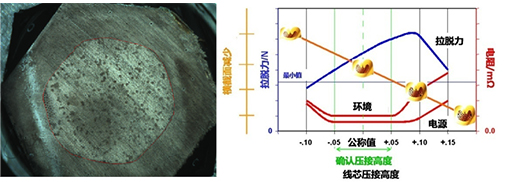
Technical Insight: Crimp Height vs. Performance
Mechanical pull-off force and electrical resistance follow a precise correlation with crimp height. As crimp height varies, pull-off force follows a bell curve, while resistance reaches a critical valley. Woer defines its manufacturing sweet spot exactly where the pull-off force is maximized and electrical resistance is minimized.
VI. Universal Vehicle Matching & Compatibility
To eliminate the field-interference issues common among first-generation charging plugs, Woer has mathematically optimized the geometric envelope of the 3rd-Gen DC Connector to guarantee flawless compatibility with leading global EV platforms:
- Latch Clearance: The height from the top of the locking hook to the top of the vehicle plug insulator is strictly limited to ≤ 18 mm , preventing any mechanical interference with the vehicle charging port trim.
- Ergonomic Body Angle: The main connector body features an engineered angle of ≥ 135°, ensuring sufficient clearance from the vehicle body during plug-in.
- Optimal Button Positioning: The distance from the actuator button to the connector head is set at ≥150 mm, keeping the user's hand clear of the vehicle flap.
- Ultra-Slim Profile: The maximum transverse width of the connector housing is kept within ≤76 mm, effortlessly clearing the vehicle charging inlet latch boundaries.
Related Product Recommendations



 Email :


